
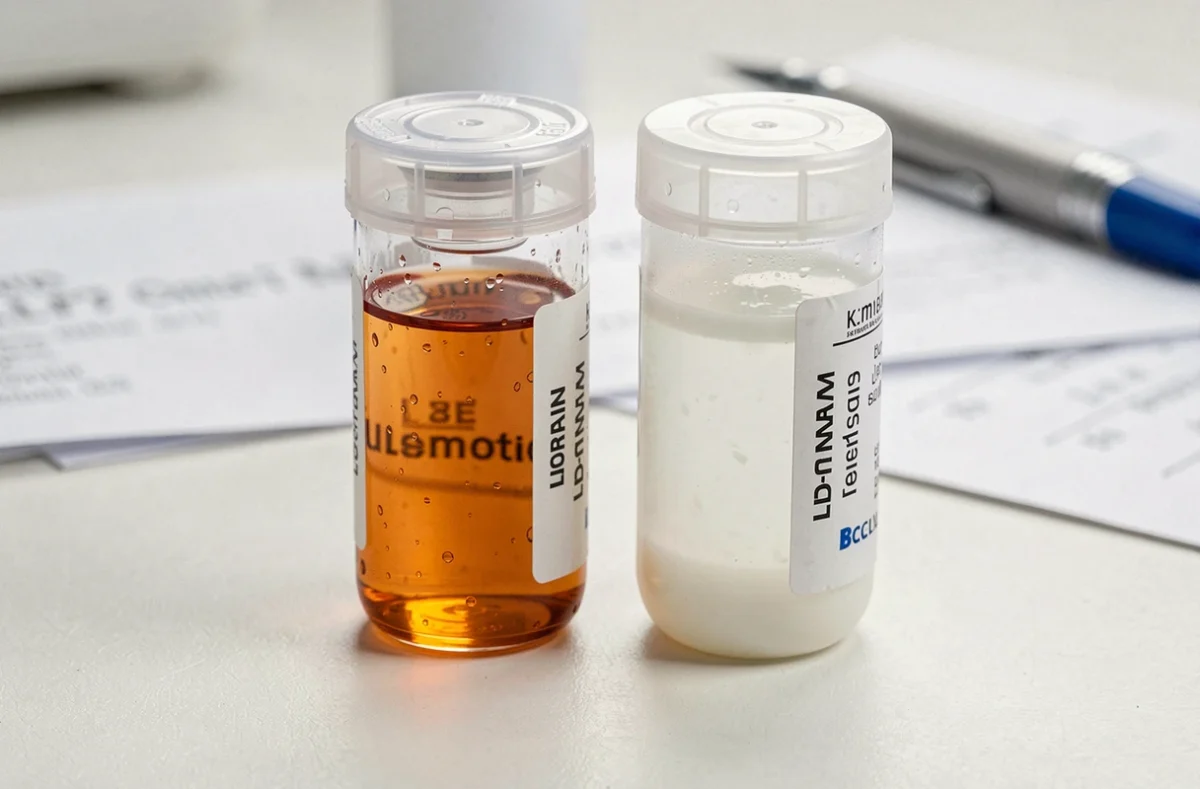
You receive your lipid panel results, and the first line mentions “serum appearance: opalescent.” When the blood draw took place a few hours after a fatty meal, this mention often triggers disproportionate concern. Opalescent serum indicates the presence of fatty particles suspended in the blood, but the clinical significance entirely depends on the context of the sample collection and the numerical values that accompany this visual observation.
Opalescent serum after a fatty meal: the mechanism at play
After a high-fat meal, the small intestine assembles the absorbed fatty acids into large particles called chylomicrons. These lipoproteins, loaded with triglycerides, enter the bloodstream via the lymphatic system. Their volume is sufficient to scatter light and cloud the serum, giving it the milky or pearlescent appearance that the laboratory describes as opalescent.
The phenomenon is better understood when we know that chylomicrons are the largest of the circulating lipoproteins. When fasting, they are normally absent or present in negligible amounts, and the serum appears clear, light yellow. Postprandial opalescence is therefore, in most cases, a direct reflection of the digestion of dietary fats, not a diagnosis in itself.
To better understand what to do in case of opalescent serum, we can distinguish two situations: one where the sample was taken without fasting, and the other where the opalescence persists despite prolonged fasting. The latter warrants medical attention.
Analytical interference: which tests can be affected by cloudy serum
Competitors often discuss the significance of opalescent serum, but rarely its concrete impact on the reliability of other analyses from the same sample. Marked lipemia does not only disrupt the lipid panel.
According to the review published in MedComm (2026), extreme concentrations of triglycerides can interfere with certain tests, particularly those for sodium, bilirubin, or other biochemical parameters. The laboratory has correction methods (ultracentrifugation, dilution, replacement of the testing technique), but not all interferences can be automatically corrected.
In practice, when the biologist observes a very cloudy serum, they can:
- Add a note of lipemic interference on the report, indicating that certain results should be interpreted with caution.
- Apply a serum clarification technique before re-running sensitive tests, which sometimes extends the turnaround time.
- Recommend a new fasting sample if the interference prevents producing usable values for the prescribing physician.
It is important to note that opalescence is not just an aesthetic detail of the tube: it can alter the reliability of results that have nothing to do with fats.
Fasting before blood draw and triglycerides: what has changed in recommendations
Fasting for twelve hours has long been considered mandatory before any lipid panel. The joint EAS/EFLM consensus published by Nordestgaard et al. in the European Heart Journal in 2016 nuanced this position: non-fasting samples are acceptable for routine lipid screening.
The distinction is made based on the medical question posed. For routine cholesterol screening in a patient without known abnormalities, a non-fasting sample is sufficient. However, when the doctor seeks to confirm very high triglycerides or clarify a result that could alter therapeutic management, fasting remains the reference.
When fasting remains necessary
If an initial non-fasting panel reveals opalescent serum accompanied by triglycerides significantly above usual thresholds, the doctor will likely request a fasting control. The goal is to check if the elevation of triglycerides persists outside of any recent dietary influence. A persistent opalescence while fasting suggests hypertriglyceridemia that requires specific management, which may range from dietary modifications to medication treatment.

What to do after receiving an opalescent result
You have received the report, and the serum is noted as opalescent. Here are the concrete questions to consider before panicking.
The first concerns the context of the sample collection. If you were not fasting, or if you had consumed a particularly fatty meal in the previous hours, the opalescence is likely just postprandial. The serum would probably have been clear with a morning fasting sample.
The second concerns the triglyceride and cholesterol values accompanying the mention. The visual appearance alone does not allow for quantifying cardiovascular risk. It is the numbers from the panel, cross-referenced with personal and family history, that guide the next steps.
- Moderately elevated triglycerides after a hearty meal, without lipid history: a fasting control is generally sufficient to clear the doubt.
- Significantly elevated triglycerides despite a fasting sample: medical consultation to explore a dyslipidemia, adjust diet, or consider treatment.
- Recurrent opalescent serum across several successive panels: a signal not to be ignored, justifying regular follow-up and evaluation of overall cardiovascular risk with the primary care physician.
What the doctor will check
The doctor does not limit themselves to triglycerides. They evaluate total cholesterol, LDL cholesterol, HDL cholesterol, and put these results into perspective with other factors: blood pressure, blood sugar, smoking, family history. An isolated opalescent serum, without associated numerical abnormalities, does not trigger treatment.
The inter-individual variability in the clearance of chylomicrons after a fatty meal explains why, with the same diet, some people present cloudy serum while others have clear serum. This difference particularly depends on the activity of lipoprotein lipase, the enzyme responsible for breaking down circulating triglycerides.
An opalescent serum after a fatty meal remains, in the majority of cases, a transient phenomenon related to digestion. The only truly useful precaution is to respect fasting before the next sample and to communicate the result to the prescribing physician so they can decide if further testing is necessary.